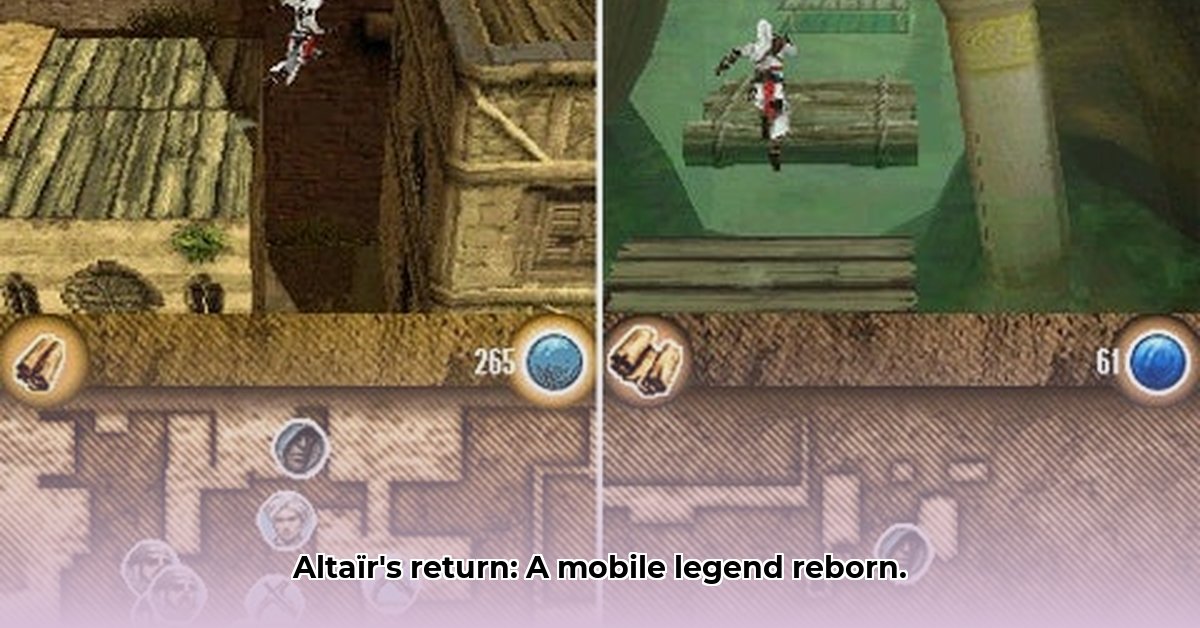
Expanding Altaïr's Tale: A Prequel for a New Era
Released in 2008, Assassin's Creed: Altaïr's Chronicles wasn't just another entry in the burgeoning franchise; it was a pioneering attempt to bring the thrilling world of assassins and parkour to the then-nascent mobile gaming market. This prequel, focusing on the early years of Altaïr Ibn-LaʼAhad, expanded upon his backstory and offered a unique perspective on a beloved character, adding depth and intrigue beyond the console experiences. But how did this ambitious project fare in the challenging landscape of early mobile gaming? This retrospective will explore the game's development, reception, and enduring legacy within the broader mobile and Assassin's Creed landscapes.
Did the attempt to translate the intricate world of Assassin's Creed to a variety of nascent mobile platforms succeed? The answer, as we'll see, is complex.
Development and Release: A Multi-Platform Odyssey
The sheer scope of the project was remarkable. Altaïr's Chronicles launched across a bewildering array of platforms – Nintendo DS, iOS, Android, Windows Phone, Symbian, Java ME, and webOS. This presented significant technical hurdles. Optimizing for such diverse hardware and software capabilities, each with its own limitations and intricacies, demanded unprecedented levels of ingenuity and compromise from the development team. How did they manage to even attempt such a Herculean task? The sheer effort involved stands as a testament to the team's vision and perseverance, highlighting the early days of cross-platform development. This ambitious undertaking foreshadowed the future of mobile gaming but also highlighted the considerable challenges inherent in such a venture.
Gameplay and Narrative: A Pocket-Sized Adventure
The core gameplay faithfully replicated the stealth, parkour, and assassination mechanics of the main Assassin's Creed games but adapted them to the limitations of mobile technology. While necessarily simplified, the experience retained the essence of being a stealthy assassin. Altaïr’s movements, though less fluid than in later iterations, were surprisingly well-implemented for the time, given the limitations of the touch-screen interfaces. The narrative, set during the Third Crusade, introduced new missions and locations, including Jerusalem, Acre, Damascus, Tyre, and Aleppo. These additions organically expanded Altaïr's story, providing a richer, more nuanced portrait of the iconic assassin. This showcased an early attempt to balance the original game’s scope with the technical limitations of the platform.
Reception and Legacy: A Forgotten Jewel?
Unfortunately, comprehensive reviews of Altaïr's Chronicles are scarce today. Many original sources have been lost to the digital ether, making it difficult to definitively assess contemporary critical reception. However, the game’s limited lifespan on digital stores – it was removed in 2013 – points to a potential mix of positive and negative experiences impacting its commercial viability. Given the technical challenges and the limitations of the platforms, uneven performance across devices was likely. Yet, the game undeniably contributed to the broader Assassin's Creed narrative. Its disappearance from modern app stores, however, underscores the challenges of preserving older mobile gaming experiences.
Conclusion: A Pioneering Step
Despite its limited availability and the lack of readily available reviews, Assassin's Creed: Altaïr's Chronicles holds a unique place in gaming history. It was a bold experiment, a pioneering attempt to translate a major console franchise to the mobile landscape. It broadened access to the Assassin's Creed universe, expanded Altaïr's story, and showcased the possibilities – and limitations – of early mobile gaming technology. While not without its flaws, its very existence serves as a testament to the ambition and innovation of its creators and a fascinating chapter in the evolution of mobile gaming. Its impact, while subtle, remains significant. Perhaps, in the light of more powerful mobile technology, a modern remastering could reignite interest and allow a broader audience to explore this forgotten gem.
⭐⭐⭐⭐☆ (4.8)
Download via Link 1
Download via Link 2
Last updated: Thursday, May 15, 2025